
What Happens in Your First Few EMDR Sessions? A Step-by-Step Guide
You've read about it. Maybe you've listened to a podcast where someone described it as the thing that finally worked. You've googled it, read the Wikipedia page, watched a YouTube video, and still aren't entirely sure what actually happens. Not in a practical, concrete, what-will-I-be-doing sense.
This is that explanation.
First, something worth knowing
Your first EMDR session probably won't involve any bilateral stimulation (the eye movements, tapping, buzzers).
That's not a delay. It's not a formality. It's the work. Before any processing begins, your therapist needs to understand you, not just what happened, but how your nervous system has learned to cope, what you're already carrying by way of skills and self-awareness, and whether EMDR is the right fit for what you're bringing. Skipping this phase doesn't speed things up. It just makes the processing less safe and less effective.
Here's how it actually unfolds.
Step 1: History taking and assessment
The first session, and sometimes the first two or three, is about building a picture. Your therapist will want to understand your history, your patterns, what's brought you here, and what's been keeping you stuck. This isn't about extracting a trauma timeline. It's about understanding you as a whole person.
You won't be asked to relive anything. You won't be pushed to go somewhere you're not ready to go. The conversation will feel more like a thorough getting-to-know-you than a clinical intake, though your therapist is paying careful attention to what's happening beneath the surface as well as what you're saying.
From this, your therapist begins what's called memory mapping, identifying the specific memories, experiences, or beliefs that are most relevant to what's happening for you now. Trauma rarely exists as a single isolated event. Memory mapping helps both of you understand the landscape before moving through it.
Step 2: Preparation and resourcing
Before any processing begins, you need to be ready for it. This is the preparation phase, and it's more substantial than most people expect.
Resourcing is a core part of this. It involves building your internal capacity to stay regulated when difficult material surfaces. In practice, that might look like:
Developing a felt sense of a safe or calm place you can return to when things get uncomfortable. Identifying what okayness or safety feels like in your body, not just as a concept but as a physical experience. Practising containment skills, ways of setting difficult material aside between sessions so it doesn't flood your day-to-day life.
How long this phase takes varies considerably. Some people arrive at EMDR having already done significant therapeutic work. They have good self-awareness, solid coping strategies, and a genuine readiness to move into processing. For them, preparation might take a session or two. For others, this phase takes weeks or even months, and that is not a detour. It is foundational to everything that follows. Processing begins when you're genuinely ready, not before.
Step 3: The first processing session
When processing does begin, here's what actually happens.
You'll be guided to bring a specific memory to mind. Not to narrate it in detail, but to hold it. Your therapist will help you identify the negative belief about yourself connected to that memory, something like "I am not safe" or "I am not enough," and where you feel it in your body. You'll give it a distress rating so you have a starting point.
Then the bilateral stimulation begins.
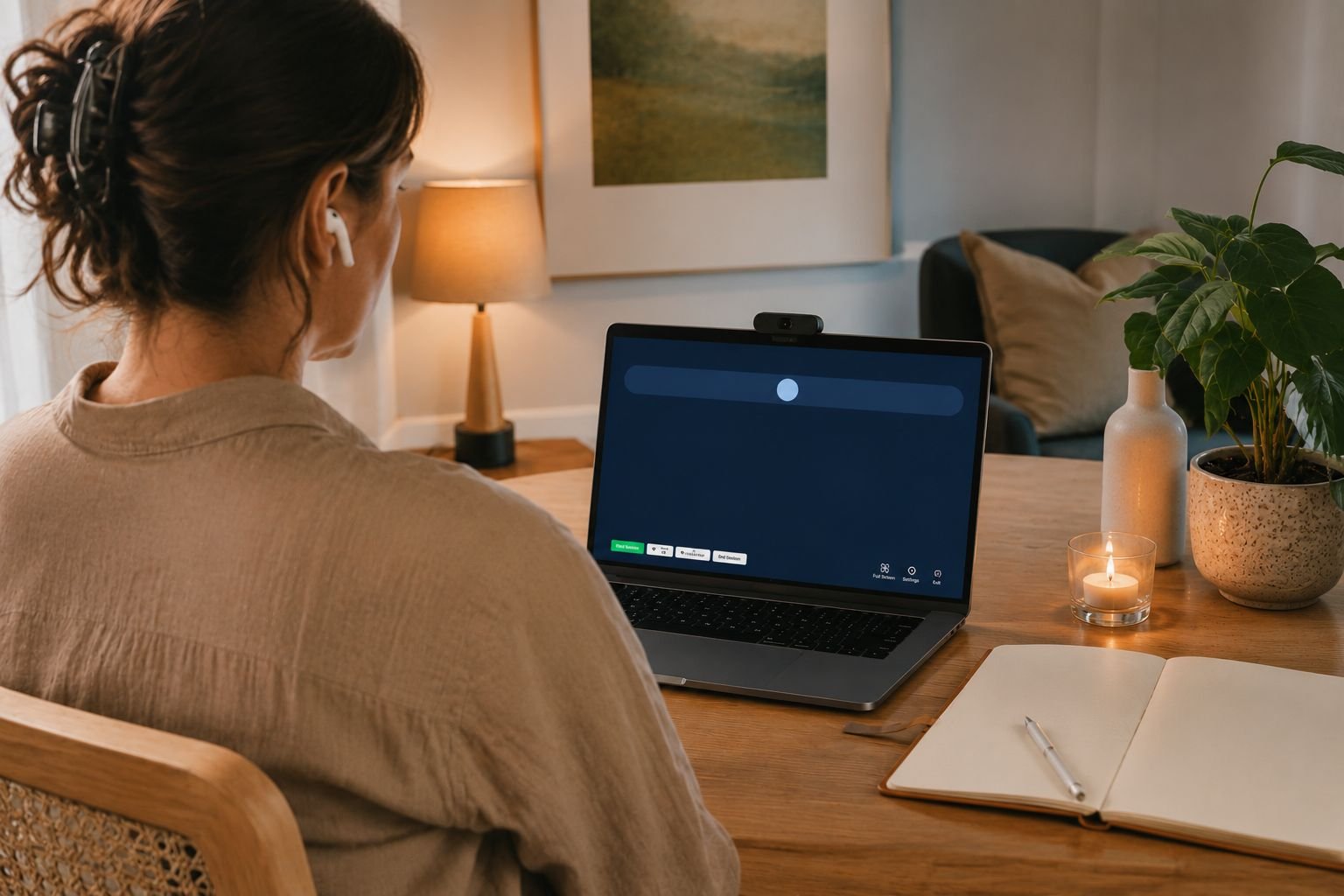
For in-person sessions, this typically involves following your therapist's fingers or a light bar moving side to side. For online sessions, a program called Bilateral Base delivers the bilateral stimulation directly through your screen. You follow a moving stimulus visually from wherever you're sitting at home. There's no need to travel, sit in a waiting room, or hold yourself together on the drive home afterwards.
Sets of bilateral stimulation are followed by brief check-ins where your therapist will ask what's coming up. You might notice images, emotions, physical sensations, memories, or thoughts that seem unrelated. All of it is part of the process. You follow whatever arises internally while your therapist holds the space. The processing is largely happening within you.
Most people find this less confronting than they expected.
Step 4: What happens after a processing session
This part matters more than people realise. EMDR processing doesn't stop when the session ends. Your brain continues integrating in the hours and days that follow. You might notice shifts in how you feel about something, memories surfacing, unexpected emotions, or a general sense that something is moving.
This is normal. It's actually a sign the work is doing what it's designed to do.
Being at home when your nervous system is integrating the work has real advantages. You can rest, be still, or simply make a cup of tea rather than managing yourself through a commute. Many people find that doing this work from home supports deeper processing, because they feel safer in their own environment from the start.
What to expect over time
Progress in EMDR doesn't always look linear. Some sessions feel significant. Others feel quieter. What tends to happen over time is that the memories you've been working on begin to lose their charge. They don't disappear, but they stop pulling on your present in the way they did.
You might notice that a situation that used to send you into a spiral now just feels uncomfortable, and you can move through it. A belief you've carried for years begins to soften, not because you've talked yourself out of it, but because the memory driving it no longer carries the same weight. Patterns that felt automatic start to shift.
EMDR is one of the most well researched trauma therapies in the world. Its effects tend to go deeper and last longer than insight alone. For many people, it reaches the places that talking simply hasn't been able to get to.
Tiffany Valente is a Clinical Psychologist and founder of The Integration Space, an online telehealth practice serving clients across Australia. She specialises in EMDR, Brainspotting, and Internal Family Systems therapy.
If you're considering EMDR and want to know whether it might be right for you, you're welcome to reach out via the contact page at theintegrationspace.au
You are not broken. You are unmet