
onLINE THERAPY AUSTRALIA WIDE
EMDR Therapy & Brainspotting
Therapy that goes deeper.
Can you relate…?
Maybe you've tried therapy before and found it helpful to a point. You understand yourself better, you can name what's happening, but something still hasn't moved. The same patterns keep showing up. The same feelings get triggered. And talking about it, as useful as that can be, doesn't seem to be shifting it.
EMDR and Brainspotting are different in that they work below the level of words and insight. They access the parts of the nervous system where unprocessed experiences actually live, helping your body complete what it couldn't at the time.
If you're curious about whether either of these approaches might be right for you, read on.
What is EMDR?
Eye Movement Desensitization and Reprocessing, or EMDR, is a therapy that works with how your brain stores difficult experiences. When something overwhelming happens, the memory can get frozen in the nervous system, still carrying the same emotional charge it had at the time. Your brain knows the event is over, but your body hasn't fully registered that yet.
EMDR uses bilateral stimulation, typically eye movements, sounds, or tapping, to gently activate both sides of the brain while you hold a difficult memory in mind. This allows the brain to do what it actually wants to do naturally: process the experience, reduce its charge, and file it away as something that happened, rather than something that is still happening.
It is one of the most well researched trauma therapies in the world, and its effects tend to go deeper and last longer than insight alone.
What is an EMDR session like?
We don't dive straight into difficult material. Before any processing begins, we spend time building a genuine therapeutic relationship and making sure you have the tools to stay grounded when things get uncomfortable.
When we do begin reprocessing, you will be guided to bring a specific memory or feeling to mind while following a bilateral stimulus. Most people find this less confronting than they expected. You don't need to narrate everything out loud. The processing happens largely within you, and I follow your lead throughout.
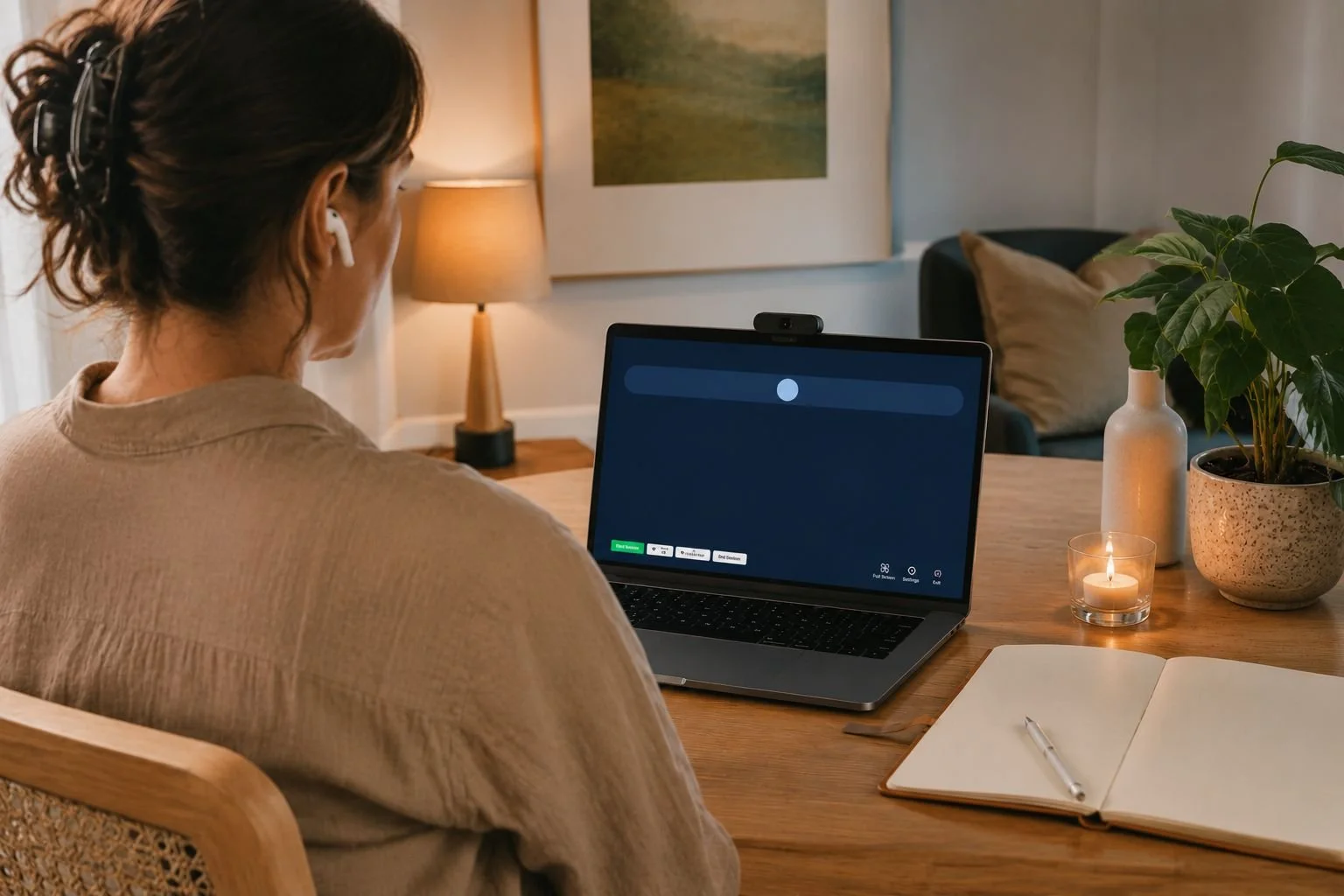
For telehealth sessions, I use a program called Bilateral Base, which runs directly through your screen. It delivers the bilateral stimulation visually, so you simply follow the movement on your own device from wherever you feel most comfortable. No need to travel, sit in a waiting room, or regulate yourself on the drive home afterwards.
That last point matters more than people realise. One of the most important phases of EMDR is what happens immediately after processing, when your nervous system is integrating the work. Being already at home, in your own space, means you can rest, be still, or simply make a cup of tea rather than having to hold yourself together on a commute. Many clients find that doing this work from home actually supports deeper processing, because they feel safer and more at ease in their own environment from the start.
Over time, memories that once felt activating tend to lose their grip. What happened to you doesn't disappear, but it stops running the show.
Your brain already knows how to process difficult experiences. It does it every night during REM sleep. EMDR works by tapping into exactly that same mechanism. Watch this short video to understand how.
What is Brainspotting?
Brainspotting is based on a simple but profound observation: where you look affects how you feel. Developed by David Grand in 2003, it works on the principle that traumatic and difficult experiences are stored not just in memory, but in specific locations in the visual field that correspond to activation in the brain and body.
By finding and holding your gaze on one of these spots, while staying connected to what you are feeling internally, Brainspotting creates the conditions for deep, subcortical processing. It bypasses the thinking mind and works directly with the part of the brain where survival responses, stuck emotions, and unprocessed experiences actually live.
It is a quieter therapy than EMDR in some ways, but no less powerful. Many people find it profound precisely because so little needs to be said.
What is a Brainspotting session like?
A Brainspotting session is spacious and unhurried. We begin by identifying what you want to work on and where you fel it in your body. That felt sense in the body becomes our compass throughout the session.
We begin by identifying what you want to work on and where you feel it in your body. That felt sense becomes our compass.
From there, we find your brainspot. A brainspot is a specific point in your visual field that has a direct neurological connection to where your brain is holding a particular experience. When your eyes land on it, something responds, a shift in your chest, a change in your breathing, a sense of something stirring. That response tells us we have found the right place.
Once we locate it, you simply hold your gaze there. Staying focused on that point while remaining connected to what you feel in your body allows the brain to process what it has been holding, in a way that talking alone rarely reaches. Think of it as giving your nervous system the sustained, focused attention it needs to finally complete what it started.
There is very little talking in a Brainspotting session. My role is to stay present with you and gently redirect your attention back to the spot when your gaze drifts. Your nervous system leads. I follow.
What arises can vary enormously. Some people experience strong emotions or sensations moving through them. Others notice very little in the moment but feel different in the days that follow. Both are normal. The integration often continues long after the session ends, which is one reason doing this work from home, already in your own space, suits Brainspotting so well.

How do I choose between EMDR and Brainspotting?
Choosing between EMDR and Brainspotting is something we can explore together. Both are powerful pathways and either can support you in reaching your goals for therapy.
EMDR
Follows a structured eight phase model
Works best when there is a specific memory, experience or belief you want to target
Involves more dialogue and verbal check ins throughout the session
Uses bilateral stimulation through eye movements, tapping or auditory sounds
You will explore the images, emotions, beliefs and body sensations connected to the memory
Builds safety and trust gradually before moving into deeper processing
Brainspotting
More open and less structured, largely led by you
You don't need a specific memory to begin, we can start with a feeling or sensation in the body
Much less talking during the session
Uses a fixed eye position, sometimes with bilateral music
Works deeply with body sensation and somatic experience
You don't need to share your full story for it to be effective

Frequently asked questions:
-
No. While both therapies are well known for their work with trauma, they are equally effective for anxiety, depression, low self worth, relationship patterns, and anything else that feels stuck. If something is causing you distress and it hasn't shifted through other approaches, these therapies are worth exploring.
-
No, and this is one of the things people are often most relieved to hear. Both EMDR and Brainspotting work below the level of words. You don't need to narrate your story in detail for the processing to happen. In Brainspotting especially, very little talking is required at all. You are welcome to share as much or as little as feels right for you.
-
Both therapies involve accessing difficult material, so it is important that you have enough capacity to stay grounded when things get uncomfortable. This is something we assess carefully before beginning any processing. If we need to spend more time building that foundation first, we will. There is no rush, and that preparation work is part of the therapy, not a delay to it.
-
Description text goes hereThis varies enormously from person to person and depends on what you are working on, how long it has been held in the body, and how your nervous system responds. Some people notice significant shifts in just a few sessions. Others do deeper work over a longer period. We will check in regularly and you will always have a clear sense of where we are and where we are heading.
-
Item descriptionMost people feel a little tender or tired after a processing session, and that is completely normal. The work continues after you leave, and your nervous system may keep integrating for a day or two. This is why doing sessions via telehealth can be so helpful. You are already at home, and you can rest, be still, or simply give yourself some quiet time rather than having to hold yourself together to get somewhere.
-
You don't need clear or detailed memories for either of these therapies to work. Brainspotting in particular can begin with just a feeling or a sensation in the body, with no specific memory required at all. The brain and body hold what they hold, and we work with whatever is present.
-
Possibly, yes, and here is why. Most traditional therapies work primarily through language and insight. They can be genuinely helpful, but they have limits. EMDR and Brainspotting work with the parts of the nervous system that talking doesn't easily reach. If you understand yourself well but something still hasn't shifted, that gap is exactly where these therapies tend to do their best work.
-
Absolutely. Anxiety is often the nervous system's way of signalling that something unresolved is still being carried. It doesn't require a single dramatic event to explain it. Both therapies work well with the underlying activation that drives anxiety, whatever its origins, and many people find lasting relief where other approaches have only offered management.
-
It varies. Some people experience strong emotions or physical sensations moving through them. Others feel surprisingly calm, almost like nothing much is happening, and then notice real shifts in the days that follow. Both are normal. You don't need to have a big emotional release for the therapy to be working. Trust the process, and trust that your nervous system knows what it is doing.
-
For EMDR, I use a program called Bilateral Base which runs directly through your screen, delivering bilateral stimulation visually so you can follow it from wherever you are. For Brainspotting, I guide you to find and hold your gaze on a specific point, which works just as effectively on screen as it does in person. Many clients actually prefer working this way. You are in your own environment, which often supports a greater sense of safety, and you can move straight into rest after the session rather than having to drive home.
-
Websites
EMDR Association of Australia: emdraa.org.au
Brainspotting: brainspotting.com
Books
The Body Keeps the Score by Bessel van der Kolk. The most accessible starting point for understanding how trauma lives in the body and why approaches like EMDR work. Widely read and highly recommended.
Brainspotting: The Revolutionary New Therapy for Rapid and Effective Change by David Grand. Written by the founder of Brainspotting, this is the go-to book for understanding what it is and how it works.
Getting Past Your Past by Francine Shapiro. Written by the founder of EMDR, this is a practical and readable guide for people wanting to understand the approach before beginning.
Podcasts
Let's Talk EMDR by the EMDR International Association. Accessible episodes covering how EMDR works and what clients can expect.
Therapy Chat with Laura Reagan. Covers EMDR, Brainspotting and somatic approaches in a warm, conversational style that is easy to listen to as a newcomer.

Your next chapter starts here
You don’t have to keep carrying this alone. If you’re ready to go deeper, heal what’s been holding you back and finally feel like yourself again - I’d be honoured to be part of your journey.